
Today is our topic of discussion Definition of Epidemic
Definition of Epidemic

Definition:
The ‘unusual’ occurrence in a community or region of a disease, specific health-related behavior or other health related events clearly in excess of ‘expected occurrence’. Example: Measles, chickenpox, cholera, swineflu etc.
Classification:
Common-source epidemics:
Single exposure or ‘point source’ epidemics:
Example – An epidemic of food poisoning.
Continuous or multiple exposure epidemics:
Example – Cholera outbreak due to drinking from a well of contaminated water.
Propagated epidemics:
It may be person to person mediated (e.g., epidemics of hepatitis A & E), arthropod vector-mediated or animal reservoir-mediated.
Slow (modern) epidemics:
Recent trend of non-communicable diseases (e.g., coronary heart disease, DM etc.) in which slow growth of these epidemics conceal their actual number.
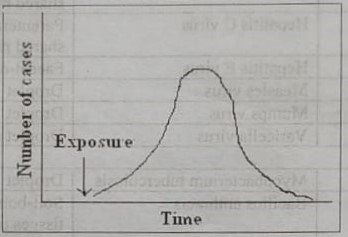
A graphical representation of time distribution of epidemic cases is called an ‘epidemic curve’. An epidemic curve gives following information:
- A time relationship with exposure to a suspected source.
- A cyclical or seasonal pattern suggestive of a particular infection and a common source or propagated spread of the disease.
The epidemic curve below illustrates the pattern of a common source, single exposure epidemic
Endemic
Definition:
It refers to the constant presence of a disease or infectious agent within a given geographic area or population group, without importation from outside. It may also refer to the ‘usual’ or expected frequency of the disease within such area or population.
Example – Filariasis is endemic in the Thakurgaon district, kala-azar on Trishal and Tangail zone of Mymensingh district, malaria in Chittagong hill tracts and goitre in northern Bangladesh, like Jamalpur, Kurigram etc.
Hyperendemic:
The term ‘hyperendemic’ expresses that the disease is constantly present at high incidence and/or prevalence rate and affects all age groups equally.
Holoendemic:
The term ‘holoendemic’ expresses a high level of infection beginning early in life and affecting most of the child population, leading to a state of equilibrium such that the adult population shows evidence of the disease much less commonly than do the children (e.g. malaria).
Pandemic
Definition:
A ‘pandemic’ is a state of epidemic, which is spreading through human populations across a large region; for instance a continent, or even worldwide. salon botten diledilo 10 rolvaried Throughout history there have been a number of pandemics, such as smallpox and tuberculosis. More recent pandemics include the HIV pandemic and the 2009 influenza (flu) pandemic.
A widespread endemic disease stable in terms of how many people are getting sick from it is not a pandemic.
Sporadic
Definition:
A disease occurring as single and scattered cases, as intermittent and in a random way. The cases are so few and separated widely in space and time that they show little or no evidence of connection with each other nor a recognizable common source of infection.
Example – polio, meningococcal meningitis, tetanus, cancer, rheumatic heart disease etc.m-non lo bono abom) wole However, a sporadic disease could be the starting point of an epidemic, when the conditions are favorable for
its spread.
Infection
Definition:
The entry and development or multiplication of an infectious agent in the body of man or animals is called infection. An infection does not always cause illness.
Level of infection (gradient of infection):
- Colonization or persistence as normal inhabitants: Example – Staphylococcus aureus in skin and normal nasopharynx.
- Sub-clinical or inapparent infection: Example – Polio.
- Latent infection: The organism remains dormant or inactive state. Example: Herpes simplex virus
- Manifest or clinical infection: Clinically apparent

Infestations
Definition:
It is the lodgment, development and reproduction of arthropods on the surface of the body or in the clothing, e.g. lice, itch mite. The term also used to describe the invasion of the gut by parasitic worms, e.g. ascariasis.
See also :